The Biggest Watch Trends of 2026, According to the Numbers
Are watches getting bigger or smaller? What’s the most popular dial color right now? Here’s what the stats say
This is an edition of the newsletter Box + Papers, Cam Wolf’s weekly deep dive into the world of watches.
Come with me into the lab this week, where I’ve cataloged 123 releases (novelties, if you hate yourself) from every major brand at Watches and Wonders to get the analytical skinny on what’s rising and falling in the watch world. I’ve done just about everything imaginable with the numbers: plotting them, running them, crunching them, massaging them to dupe my investors (oh no, I’m in too deep!). Here’s what I found.
Dials are like your favorite Miles Davis record
No, not Bitches Brew. Although this is my first time embarking on this project, I imagine that blue is the dominant dial colour almost every year at Watches and Wonders. This year, the hue was everywhere again—it appeared on the faces of 32 new pieces (that’s over a quarter of them!). Its dominance was epitomized by Chopard’s collector-darling L.U.C, which swapped out its salmon dial for a deep shade of blue this year. As Tony Traina wrote in his story about the watch for GQ, it might not be the most exciting change, but it’s one that makes the watch even more wearable on a day-to-day basis. That’s why brands keep coming back to the colour so frequently.
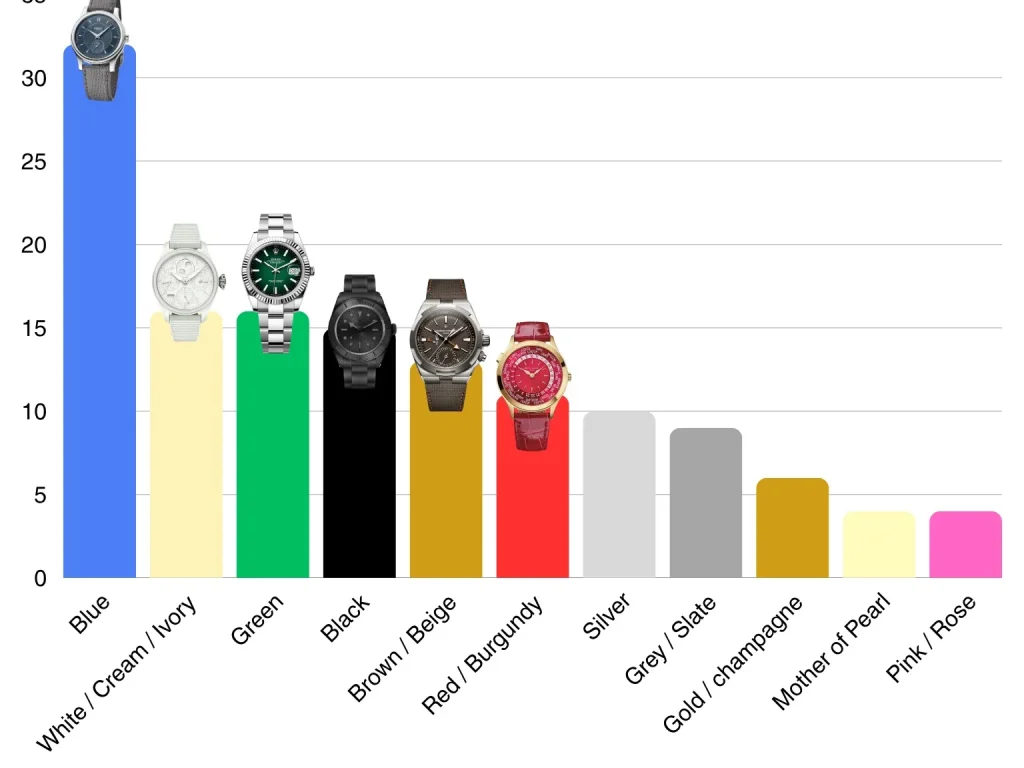
Even in the moment, though, it felt like green dials were having a moment. That’s backed up in my data, which counts 16 releases featuring the verdant shade. It had plenty of company from more standard neutral tones: There were also 16w new watches with white/cream/ivory dials, 15 with black, and 13 with brown or beige.[table]
The secret winner of the dial wars…
What really stood out when I put all the new releases together is just how many skeletonized and openworked dials were part of the slate. If you considered them a dial shade, they would rank second behind blue, with over 20 new releases showing off their guts. This will be a trend we see repeatedly as we rummage through the data, but watch brands seem to be relentlessly pushing toward gaudier materials, grander complications, and more premium pricing.
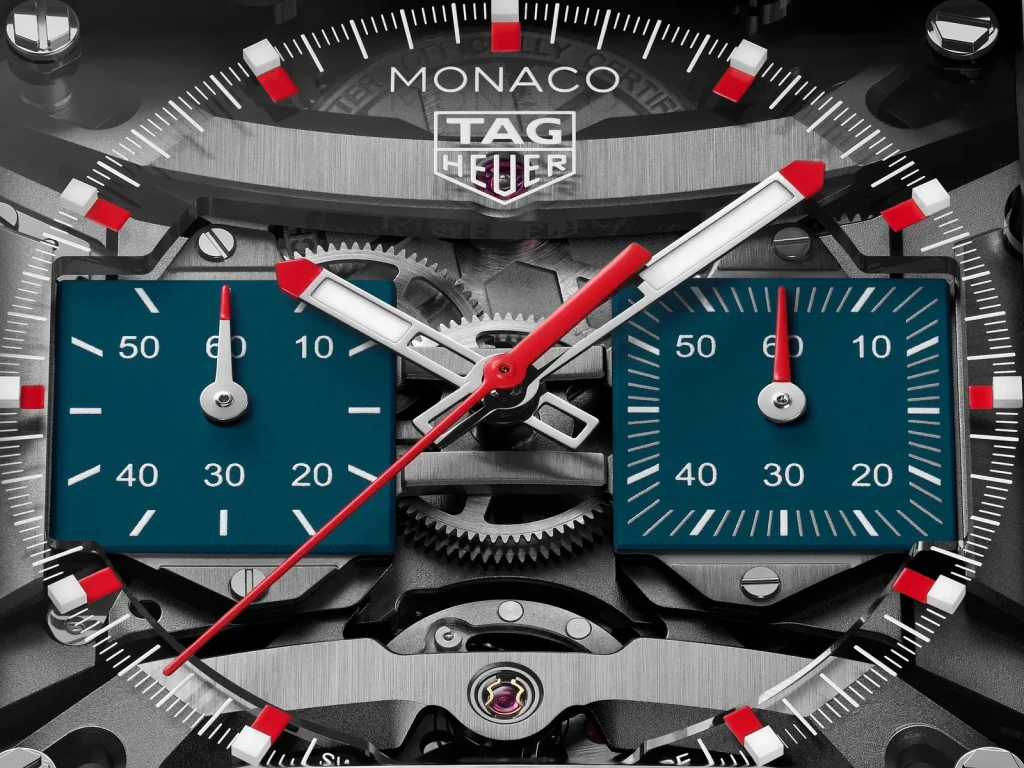
Going skeleto-mode is one way for watchmakers to make their pieces feel more luxurious. It’s a move I saw employed up and down the spectrum, from Patek Philippe’s new $190,000 Cubitus to TAG Heuer’s premo “Evergraph” Monaco, which clocks in at $25,000. Panerai, Jaeger-LeCoultre, Zenith, Hermès, Chopard, Chanel, and Cartier all got in on the action as well. Opening a dial now seems to be the go-to button watchmakers push when they want to take one of their icons and make it appeal to clients with deeper wallets.
All that glitters is gold
Speaking of brands finding ways to swim further upmarket: Gold was a massive winner at Watches and Wonders this year. In fact, would you believe there were more new gold watches on display than steel ones? That’s maybe the most shocking number to come out of all this—out of the 120+ pieces I compiled, 47 came in gold, while 46 of them were made out of steel.
| Case material | Number of watches |
| Gold | 47 |
| Steel | 46 |
| Titanium | 24 |
| Platinum | 13 |
| Ceramic | 9 |
The data puts a fine point on the state of the industry. It’s a growing trend that shows up in several ways. Look at the annual Morgan Stanley report on the industry, which has shown for the past several years that while the overall volume of watches Switzerland is exporting has decreased, the value of those exports has actually gone up. It’s proof that the industry is focusing more on selling high-value watches than selling them in huge numbers. One prominent example is IWC’s sporty Ingenieur, which now comes in a solid gold model with a tourbillon ($159K). Even beloved affordable watchmaker Nomos made a version of its Tangente in gold this year, bumping the watch’s price tag up from $4,690 to $16,100.
The most popular versions of the precious metal were white and yellow gold. They were tied at the top with 16 watches.
Titanium also seems to be on the rise. There were 24 watches made out of the light, easy-wearing material this year. While the material is typically considered cheaper even than steel, it’s now being used in premium watches like Ulysse Nardin’s Super Freak ($393,600) and Vacheron Constantin’s Overseas Dual Time Cardinal Points ($41,000).
Write these numbers down and slide them across the table
The bad news: the middle ground of pricing is practically barren. Only 19 watches are priced between $10K and $25K, and only nine appear in the $7K to $12K range (what I consider as just above entry-level in the luxury watch market). Even pulling together the best “relatively” affordable watches—our made-up cut-off was $6,000—was a challenge this year. That makes sense when you see what the typical piece was priced at.
The true average (the mean) was a gobsmacking $66,232, a number punched up with helium from the super-higher-priced models. But the median isn’t much less scary: $31,000.
Finding the perfect size
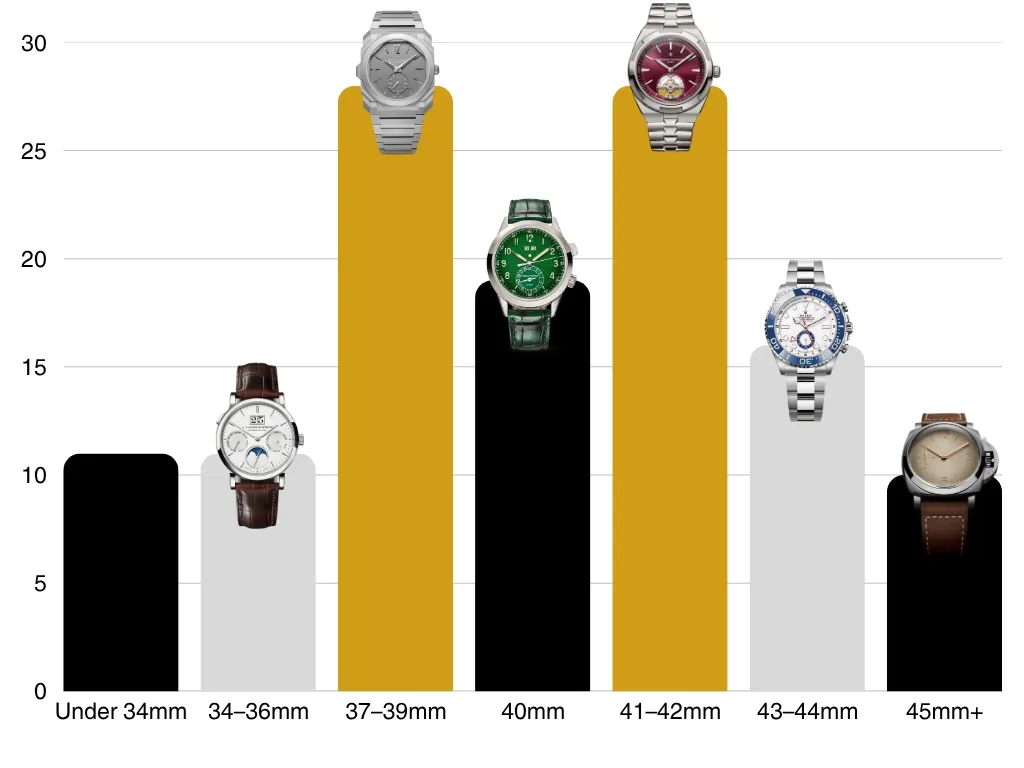
Averaging together the case sizes of all 123 watches spit out a shockingly round number: 40 mm. That really is the magic number in terms of watch sizing for the typical modern customer, so it’s funny to see it reflected so cleanly in the stats.
That average also speaks to a very equal distribution up and down the spectrum. I counted 11 34 to 36 mm watches and 28 that measured 37 to 39 mm. That’s almost a perfect mirror to the 28 models at 41 to 42 mm and 15 weighing in at the heftier 43 to 44 mm. The real sweet spot is the 37 to 42 mm band, where nearly 62.5% of the watches in my database landed.
Other stray thoughts:
Thinness is the new luxury. The number of brands developing and marketing “ultra-thin” movements really stood out. Vacheron, Patek Philippe, Chopard, Cartier, Bulgari, and Piaget all called out their GLP-1’d movements. This is a true difference maker for customers, even if it doesn’t pop on JPEGs.
Complications are part of the premium push, too. What does it say about the state of the industry that Watches and Wonders featured just as many perpetual calendars and tourbillons as chronographs? While the chrono was the king of complications (outside of a simple date function), there were only two and three fewer perpetuals and tourbillons, respectively. In other words: Watch brands are just as committed to super premium watches as ready-to-rock sport ones. That becomes even more evident when you consider that many of the chronographs, including models from Patek and Parmigiani Fleurier, cost tens of thousands of dollars.
We might be turning the corner on stone dials. Although stone dials appeared on some headline-grabbing releases like Zenith’s G.F.J and Rolex’s new Day-Date, they only accounted for six total watches that I counted. Given the considerable hype around this trend in past years, that number feels notably low.